
A new opportunity for UK charities: the charitable purposes soft opt-in
Blog
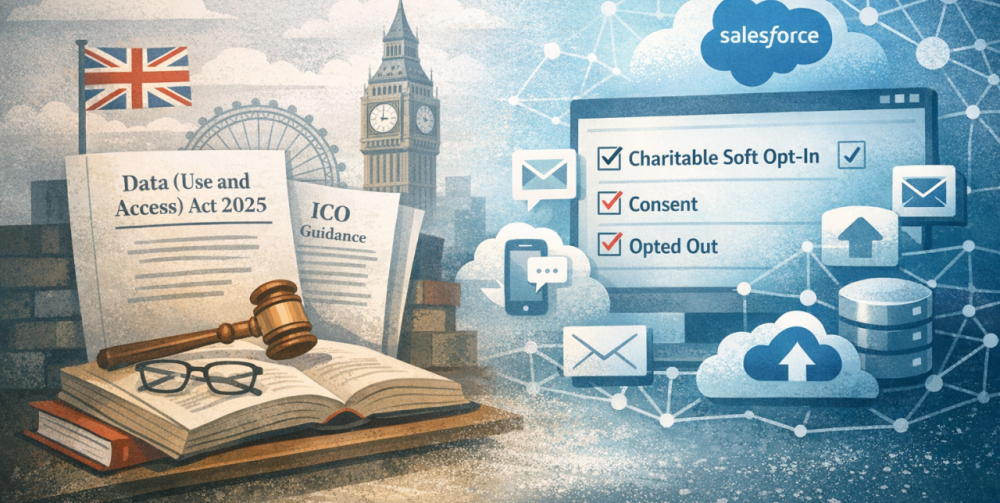
A change in UK law that quietly came into force in February 2026 has just got a lot clearer. On 28 April, the Information Commissioner’s Office (ICO) published its final guidance on the “charitable purposes soft opt-in” – a new provision introduced by the Data (Use and Access) Act 2025.
For many UK charities, this is genuinely good news. But it does require some deliberate work to implement correctly. And if you use Salesforce, some of that work sits squarely in your CRM.
What is the charitable purposes soft opt-in?
Under PECR (Privacy and Electronic Communications Regulations), charities have historically needed explicit consent before sending marketing emails or texts to supporters. If a donor gave without ticking an opt-in box, contact was lost. That was a significant problem – estimates suggest the sector loses around £290 million annually as a result.
The new provision changes that. From 5 February 2026, registered UK charities can send direct marketing by email, text, and social media direct message to supporters without prior consent, as long as six requirements are all met:
- You are a registered charity under UK law (England and Wales, Scotland, or Northern Ireland).
- You collected the contact details directly from the person. This means no third-party sources – such as JustGiving or a telemarketing agency – will qualify as a valid soft opt-in.
- You collected those details in the course of them expressing an interest in, or offering support for, your charitable purposes. This includes donations, volunteering sign-ups, event registrations, newsletter requests, and more.
- The marketing is solely to further your own charitable purposes – fundraising appeals, volunteer asks, campaign updates, impact reporting.
- You gave them a clear opt-out opportunity at the point of collection.
- You include an opt-out in every subsequent message.
That last requirement is perhaps the most important to internalise: this is opt-out, not opt-in. You’re changing the default, but people’s right to say no must always be easy and clear.
This is an opportunity, not an obligation
It’s worth being explicit: you don’t have to use this. If your existing consent-based marketing is working well, there’s no reason to disrupt it. The soft opt-in is an additional option for new contacts going forward – it cannot be applied retrospectively to contacts already in your database. Anyone already on your system under a consent basis stays under that basis.
For charities where consent rates are low and significant supporter engagement is being lost, this provision could be transformative. For others, it may have limited immediate value. The decision to adopt it should be deliberate, not reflexive.
Four things that need to change if you decide to proceed
If your charity decides to take up this provision, it creates work across four areas:
- Your Salesforce instance and consent processes need updating. Salesforce will need to correctly capture, store, and distinguish between contacts held under the charitable purposes soft opt-in versus consent, versus the commercial soft opt-in, versus those who have opted out. These are distinct populations requiring distinct handling in your data model and your marketing consent fields.
- Data import routines need updating. Any process that brings new contacts into Salesforce – donation landing pages, event registrations, web forms – needs to correctly flag the lawful basis under which those details were collected, and only apply the soft opt-in to data collected directly by your charity – not by a third party.
- Privacy notices and supporter-facing forms must change. Every form where you collect contact details needs a clear, plain-English opt-out option at the point of collection, and copy that tells people how their details will be used. This is a requirement, not best practice.
- Staff training is required. The ICO specifically calls this out. Anyone handling supporter queries needs to understand what has changed, and your fundraising and marketing teams need to understand what can and can’t go into a message sent under each different basis.
Where Giveclarity can help
Items 1 and 2 are Salesforce questions, and they’re the kind we answer every day. Getting the consent data model right in Salesforce is not trivial – particularly where charities need to maintain separate audiences for the charitable purposes soft opt-in, the commercial soft opt-in, and traditional consent-based marketing, all with their own opt-out handling and suppression logic.
Getting data imports right is equally critical. The non-retrospective rule means your system needs to correctly distinguish between records collected before and after the commencement date. A misconfigured import routine is a compliance risk.
Items 3 and 4 – updating your privacy notices and training your team – sit outside our wheelhouse as a Salesforce partner, but we are happy to point you in the right direction. The ICO’s own guidance, updated this week, is the right place to start.
As a Salesforce Partner specialising in Salesforce fundraising solutions for nonprofits we have years of experience of building consent solutions for our customers and have built up re-usable collateral that helps to deliver effective solutions quickly.
Next steps
If you’d like to understand what it would take to update your Salesforce instance to support the charitable purposes soft opt-in, get in touch. We can assess your current data model and consent setup, and help you implement the changes correctly.
About the author:
Aske Bong-Saxe is our Solutions Architect